Brazed Diamond Wheel for Ductile Iron Axle Housing Swing Grinder Cleaning
By
castgrindsolutions.com
1. Overview of Workpiece
The workpiece discussed in this article is a through-type intermediate axle housing blank for heavy-duty commercial vehicles. It is integrally cast from high-strength QT700-2 ductile iron, serving as a core load-bearing and transmission component for dual-drive vehicles.
The casting features a large central cavity for differential assembly, extended half-shaft sleeves on both sides, and integrated spring brackets & thrust rod mounting bosses on the housing. Each blank weighs considerably. After casting, excess structures including gating systems, feeding risers, parting line flashes and sand adhesion remain on the workpiece. These redundant sections must be removed via cutting and grinding before subsequent processes such as stress relief annealing, CNC machining and non-destructive testing.
The workshop adopts a standardized cleaning production line equipped with rail-adjustable positioning fixtures, jib cranes, swing grinders and handheld angle grinders. The line separates rough cutting of risers and fine grinding of flashes into independent stations. Industrial ventilation fans and full personal protective equipment are deployed across the workshop to support continuous mass production and safe operation.
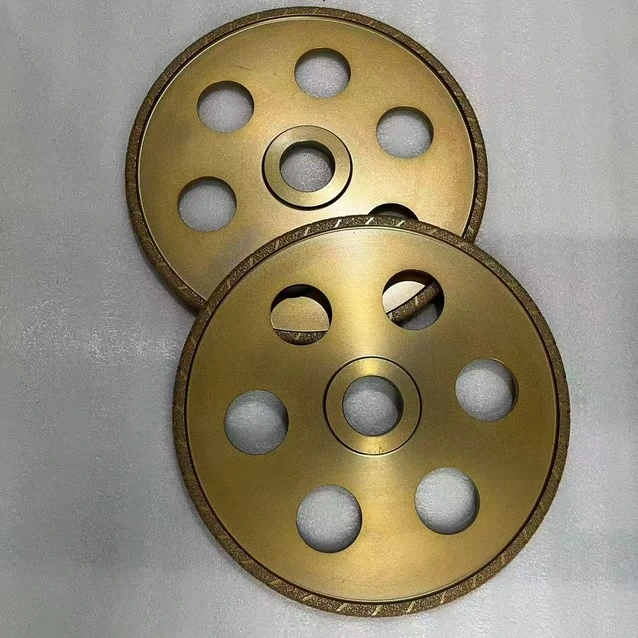
For riser cutting of axle housing blanks, the swing grinder is fitted with custom brazed diamond grinding wheels with standardized dimensions below:
Outer Diameter: 500mm
Thickness: 25mm
Bore Size: 75mm
This diamond wheel is engineered specifically for rough cutting of heavy ductile iron castings. It matches the swing travel of the grinding machine, enabling one-pass cutting of thick casting risers and heavy feeding ribs on large axle housings. As a high-performance alternative to conventional resin cutting discs and silicon carbide grinding wheels, it has become the key consumable for foundry cleaning workshops.
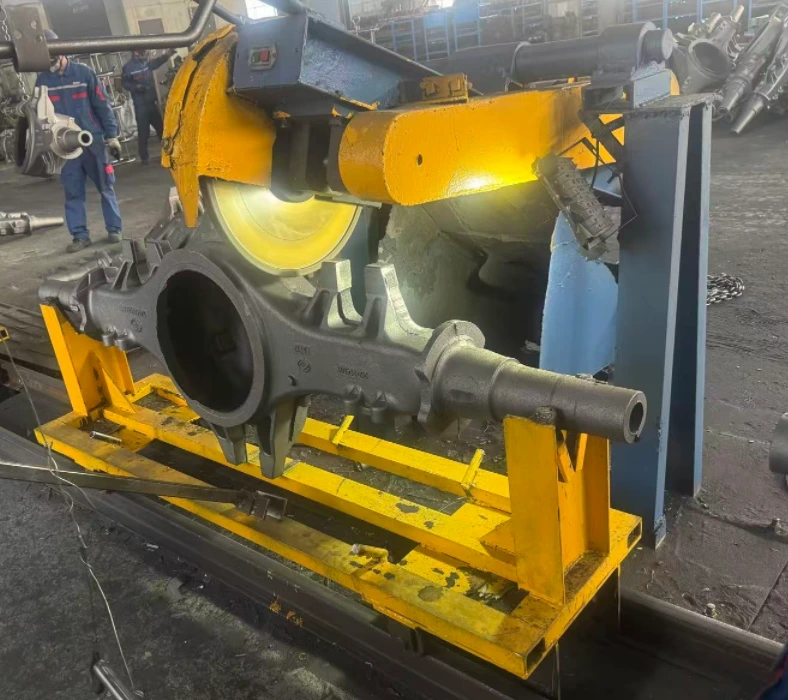
QT700-2 ductile iron axle housing casting before swing wheel cutting
2.1 Full Configuration of Swing Grinder
Rail-mounted Adjustable Fixture Supports
V-shaped positioning brackets are installed to fit the irregular curved profile of axle housings. The clamps firmly lock workpieces to counteract cutting impact, eliminating vibration and shifting to guarantee straight, uniform cutting edges. The sliding rail allows forward/backward fine-tuning of workpieces to align cutting points for different axle housing models.
Heavy-duty Floor Swing Grinder Main Unit
The machine features a heavy spindle to mount large-size grinding wheels, protected by an integrated yellow curved safety guard fully covering the cutting zone. The barrier blocks hot metal chips and sparks to prevent workplace burns and fire hazards. Its swing cantilever structure enables vertical and horizontal oscillating feed movement to follow uneven contour surfaces of casting risers.
Jib Crane Material Handling System
A rotating jib crane is installed above each workstation. A single axle housing blank weighs nearly 400kg, making manual lifting impossible. The crane automates loading, unloading and workpiece transportation to eliminate heavy lifting risks for operators.
2.2 Process Purpose of the Cutting Station
During casting pouring, gating systems, feeding risers and feeding ribs are essential channels to deliver molten metal and compensate casting shrinkage. These protruding metal structures are redundant after solidification and cannot proceed directly to machining.
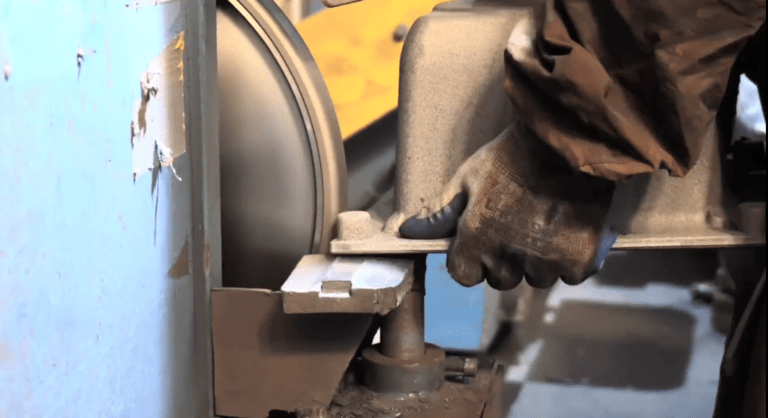
The core function of this station is to use large diamond wheels to cut off thick risers and massive feeding ribs in a single pass, rapidly removing excess casting material. This drastically reduces metal allowance for downstream manual fine grinding, forming the primary rough cleaning step for raw castings. High-speed grinding generates massive hot metal sparks and fume, making this a concentrated dust and heat source within the workshop.
2.3 Workplace Safety Supporting Facilities
Personal Protective Equipment (PPE)
All on-site operators are fully equipped with dust & gas respirators, thick cut-resistant gloves and hard hats to block ductile iron dust and hot chips, preventing respiratory injuries and thermal burns.
Workstation Ventilation System
Heavy-duty portable axial flow fans are placed across the workshop, blowing air directly toward cutting & grinding zones to exhaust graphite dust and hot fume, improving air quality inside enclosed factory buildings.
Centralized Waste Collection
Large yellow waste hoppers are arranged alongside the production line to collect all grinding metal scraps uniformly for remelting recycling. Contained debris also eliminates slippery metal fragments on floors to reduce slip-and-fall accidents.
Built-in Machine Safety Features
The grinding wheel is fully enclosed by protective housing, and each machine is fitted with emergency stop buttons. Operators can instantly halt operation in case of wheel chipping, workpiece displacement or other malfunctions to avoid mechanical safety incidents.
3.1 Extremely Long Service Life, Minimize Downtime for Wheel Replacement
Conventional resin and silicon carbide wheels wear out rapidly when grinding ductile iron, requiring frequent replacement after processing only a small batch of castings. Brazed diamond wheels adopt high-hardness diamond abrasives with ultra-strong bonding retention and outstanding wear resistance. A single diamond wheel can process hundreds of axle housing blanks, drastically cutting downtime caused by wheel swapping and fixture calibration, and maximizing continuous line productivity.
QT700 ductile iron is highly sensitive to high-temperature burning and residual stress. Traditional grinding wheels create excessive friction heat during cutting, which easily causes surface annealing and internal processing stress on castings, raising cracking risks in later service. Brazed diamond wheels deliver sharp cutting edges with low cutting resistance and smooth feeding. Less heat transfers to the base metal during contact, avoiding thermal burning on axle housings and lowering stress control burdens for subsequent heat treatment processes.
Resin wheels wear continuously during high-speed operation, shrinking radially rapidly. This leads to inconsistent cutting depth and uneven cut surfaces, resulting in over-cutting or excessive residual flashes. The 500mm OD brazed diamond wheel wears at an even, slow rate with minimal outer diameter reduction throughout its service life. It produces smooth, uniform cutting edges with consistent residual allowance after riser removal, significantly lowering the workload of downstream handheld grinding and stabilizing semi-finished casting quality.
3.4 Less Dust & Sparks, Improved Workshop Working Environment
Cutting with traditional resin wheels generates large volumes of resin matrix dust and dense hot sparks, creating severe air pollution and potential fire risks. Diamond wheels contain no consumable resin substrate, producing only ductile iron metal dust during operation. Spark generation is greatly reduced, and paired with workshop ventilation fans, the workstation atmosphere can be purified efficiently, mitigating risks of dust explosion and occupational health hazards.
3.5 Lower Comprehensive Operation Cost, Ideal for Mass Production Lines
Although the upfront purchasing cost of diamond wheels is higher than conventional abrasives, their service life is dozens of times longer. The consumable cost allocated to each single axle housing is far lower. Fewer wheel replacements also cut labor costs and production downtime losses. For foundry workshops running continuous high-volume production, brazed diamond wheels deliver remarkable overall cost optimization.
3.6 High Rigidity Matches Swing Grinder Working Conditions
The 25mm thick wheel substrate enhances overall structural rigidity, resisting deformation and edge chipping under reciprocating cutting impact from swing grinders. The standard 75mm bore fits machine spindles perfectly for stable installation with zero vibration during oscillating cutting, delivering steady performance even on uneven, contoured risers of axle housings.
4. Complete Casting Cleaning Process Flow
Shakeout & Sand Removal: Cooled castings go through shakeout to eliminate surface molding sand, then transferred to the cleaning production line.
Rough Cutting with Diamond Wheel: Jib cranes load axle housings onto rail positioning fixtures. The swing grinder equipped with 500×25×75mm brazed diamond wheel cuts off all gating systems and main feeding risers in one operation.
Manual Flash Fine Grinding: Operators use handheld grinders to remove residual flashes from cutting, parting line protrusions, sand adhesion and sharp corners across the housing surface.
Stress Relief Annealing: Eliminate internal stress generated during casting, cutting and grinding to prevent workpiece deformation and cracking.
Precision CNC Machining: CNC boring and milling machines process differential cavities, half-shaft bearing holes and all mounting reference surfaces.
NDT Inspection & Coating: Magnetic particle or penetrant non-destructive testing detects microcracks. Castings receive electrophoretic anti-rust coating before assembly into complete axle modules.
5. Production Line Application Value Summary
Heavy-duty commercial vehicle axle housings are safety-critical load-bearing castings. Foundry cleaning procedures directly determine semi-finished product yield and efficiency of all downstream machining processes. The matching combination of 500×25×75mm thick brazed diamond wheel and swing grinding machine provides targeted optimization for cutting thick risers on ductile iron heavy castings. It balances processing efficiency, workpiece quality, workplace environment and long-term production costs. This abrasive solution is ideal for foundry cleaning lines pursuing higher output and lower operating expenses, and can be widely promoted for mass cleaning of all types of large cast iron housings and structural components.