How Electroplated Diamond & CBN Tools Are Made: A Step-by-Step Process
Before we dive into the FAQs, it helps to understand exactly how electroplated diamond and CBN tools are manufactured. The process determines tool performance, consistency, and service life.
Electroplated diamond tools are made by using nickel to bond diamond grains onto a metal substrate (the base body). The diamond particles are partially embedded in the nickel layer, with the remaining portion exposed above the surface. This creates a durable, sharp, and wear-resistant working layer.
Why electroplate?
The goal is to coat a metal workpiece with a dense layer of diamond (or CBN) particles, giving it exceptional cutting and grinding ability. Tools made using this process are widely used in machinery, glass processing, construction materials, and many other industries.
Below is the typical manufacturing process for electroplated diamond and CBN tools.
Step 1: Diamond / CBN Raw Material Preparation
The process begins with selecting the correct abrasive grit size, based on the required precision of the finished tool.
-
Under a microscope, synthetic diamond appears as multi-faceted, angular particles with a yellowish-green color.
-
To ensure quality, a magnetic separator is used to remove impurities from the diamond or CBN grains, improving purity and consistency.
Step 2: Degreasing (Oil Removal)
Any oil or grease on the abrasive or the workpiece will prevent proper bonding.
-
For the abrasive: Industrial alkali (caustic soda) is added to water and boiled for 30 minutes. The abrasive is then rinsed 2–3 times with distilled water to remove surface oil.
-
For the workpiece (tool body): The metal substrate is placed in an ultrasonic cleaner with caustic soda solution. The water is heated to dissolve the alkali, and ultrasonic cleaning runs for 30 minutes.
Step 3: Pre-Plating (Strike Layer)
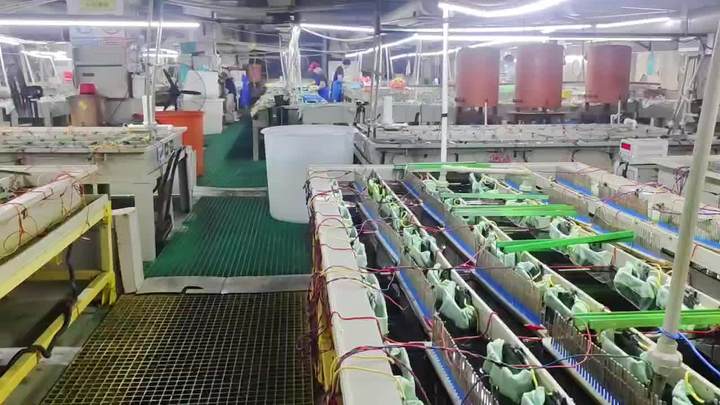
To ensure a strong bond between the abrasive and the substrate, a thin initial nickel layer is applied before the diamond or CBN is added.
-
The electrolyte solution is heated to 50°C.
-
The workpiece is placed in a charged plating tank.
-
Through electrolysis, nickel ions react and deposit onto the workpiece surface, forming a thin, uniform pre-plating layer.
Step 4: Electroplating (Abrasive Application)
This is the core step: embedding diamond or CBN grains into the pre-plated surface. Two common methods are used, depending on the tool shape.
| Method | How it works | Best for |
|---|---|---|
| Sand dropping method | Abrasive is dropped onto one surface at a time | Single-sided tools (e.g., flat cutting discs) |
| Sand burying method | The workpiece is buried in abrasive grains | Cylindrical or irregularly shaped tools (e.g., mounted points, core drills) |
The principle is the same for both methods:
The workpiece and electrolyte are energized. Diamond or CBN grains are brought into contact with the pre-plated surface. Under the electric field, nickel releases nickel atoms, which deposit onto the workpiece—gradually encapsulating the abrasive grains and locking them into a strong nickel matrix.
The result: a dense, single-layer superabrasive coating.
Step 5: Washing & Drying
After electroplating, the tool is thoroughly rinsed with clean water to remove any residual electrolyte and loose abrasive grains trapped between the particles.
Finally, hot air is used to evaporate all moisture from the tool surface. The electroplated diamond or CBN tool is now complete and ready for use.
Important Safety & Process Control Notes
Based on real workshop experience, the following points are critical for consistent quality and operator safety:
| # | Consideration | Why it matters |
|---|---|---|
| 1 | Personal protective equipment (PPE) | Wear gloves and goggles. Electrolytes can cause chemical burns to skin and eyes. |
| 2 | Good ventilation | Electroplating can release harmful gases. Ensure adequate fume extraction. |
| 3 | Strict temperature control | Electrolyte temperature must be held to specification. Too high or too low affects plating quality. |
| 4 | Prevent contamination | Keep impurities out of the plating bath. Contaminants destabilize the electrolyte and reduce bond strength. |
| 5 | Regular bath testing & adjustment | Electrolyte composition changes over time. Test periodically and adjust or replace as needed. |
| 6 | Proper workpiece preparation | The substrate must be clean, oil-free, and rust-free before plating. Surface quality directly affects adhesion. |
| 7 | Follow standard operating procedures (SOP) | Do not improvise. Strict adherence to the process ensures repeatable, high-quality tools. |
The above is based on hands-on manufacturing experience. If you have questions or corrections, feel free to leave a comment. Follow me for more practical knowledge on electroplating technology.
Now to Your Frequently Asked Questions
Now that you understand how electroplated diamond and CBN tools are made, let’s answer the most common questions about selecting, using, and maintaining them.
Electroplated Diamond & CBN Tools: Your Top 10 Questions Answered
Struggling to choose between diamond and CBN tools? Wondering why your cutting disc wears out too fast? You’re not alone.
In precision machining, using the wrong superabrasive tool can cost you time, money, and quality. Below, we answer the 10 most common questions about electroplated diamond and CBN tools—so you can make the right choice the first time.
1. What is the difference between electroplated diamond and electroplated CBN tools?
Answer:
The difference lies in the abrasive material and what you are cutting.
| Feature | Electroplated Diamond | Electroplated CBN |
|---|---|---|
| Hardness | Extremely hard (highest) | Slightly lower than diamond |
| Thermal Stability | Up to ~700–800°C | Up to ~1300–1400°C |
| Chemical Reactivity | Reacts with iron/steel | Inert to iron/steel |
| Best for | Non-metals (glass, ceramic, stone, semiconductor) | Hard metals (hardened steel, cast iron, superalloys) |
Golden rule: Non-metal → Diamond. Hard metal → CBN. Using diamond on steel will cause rapid chemical wear.
2. Why can’t I use diamond tools on steel or iron?
Answer:
Because diamond is made of carbon. At high temperatures (above 700°C), carbon from the diamond dissolves into iron/steel through a chemical reaction. This causes the diamond grains to “graphitize” and wear out extremely fast—often in seconds.
CBN (Cubic Boron Nitride) does not react with iron, which is why it is the correct choice for grinding hardened steels, cast iron, and nickel-based alloys.
3. What are the main advantages of electroplated tools over resin or vitrified bond tools?
Answer:
Electroplated tools offer four unique advantages:
| Advantage | Why it matters |
|---|---|
| High grain exposure | No wheel loading, cooler cutting, less thermal damage to the workpiece |
| Sharp cutting action | Higher material removal rates, shorter cycle times |
| Lower initial cost | Only 1–2 layers of abrasive, less expensive to manufacture |
| Unlimited shapes | Easy to customize for complex profiles or small batches |
Limitation to know: Electroplated tools have only one abrasive layer. They cannot be dressed or trued. For very high-volume, continuous production, a vitrified CBN wheel may be more economical in the long run.
4. How do I choose between a cutting disc, a grinding wheel, and a mounted point?
Answer:
Choose by the shape of the area you need to machine.
| Tool Type | Best for | Example |
|---|---|---|
| Cutting disc | Straight-line cutting, slotting, parting off | Cutting glass tiles, slicing hardened steel bars |
| Grinding wheel | Surface grinding, cylindrical grinding, form grinding | Flattening ceramic plates, grinding gear teeth |
| Mounted point | Internal grinding, contour finishing, deburring, polishing | Finishing a mold cavity, polishing a jade carving |
Tip: If your feature is larger than your fist → wheel or disc. If it’s small, curved, or hard to reach → mounted point.
5. What grit size should I use for roughing vs. finishing?
Answer:
Grit size is measured in mesh (#). Lower number = coarser. Higher number = finer.
| Application | Recommended Grit | Surface Result |
|---|---|---|
| Heavy stock removal / roughing | #40 – #80 | Rough, fast cut |
| General purpose grinding | #100 – #200 | Medium finish |
| Semi-finishing | #200 – #400 | Smooth |
| Finishing / polishing | #600 – #3000 | Mirror-like |
Practical advice: Start with a coarse grit for material removal, then switch to a fine grit for finishing. Do not try to remove a lot of material with a fine grit wheel—it will glaze and burn the workpiece.
6. How long do electroplated diamond and CBN tools last?
Answer:
It depends on the material, grit size, and operating conditions. However, compared to conventional abrasive tools (like aluminum oxide or silicon carbide):
-
Electroplated diamond tools typically last 10–50x longer on non-metals.
-
Electroplated CBN tools typically last 10–20x longer on hardened metals.
Real-world example: A CBN wheel grinding a hardened steel automotive camshaft may process 50,000–100,000 parts before needing replacement. An aluminum oxide wheel might only process 5,000–10,000 parts.
7. Can you make custom shapes or non-standard sizes?
Answer:
Yes—and this is one of the biggest strengths of electroplating.
Unlike sintering or brazing, electroplating does not require high temperatures or expensive molds. This means:
-
Any shape: Threaded forms, concave/convex radii, tapered cones, special step profiles
-
Any size: From 0.5 mm micro pins to 800 mm large wheels
-
Small batches accepted: Even 1–10 pieces are feasible for prototyping or repair work
What we need from you: A drawing (DXF, PDF, or sketch) showing dimensions, tolerance, and required grit.
8. What is the maximum safe operating speed?
Answer:
It depends on the bond strength and the tool’s backing material (usually steel or aluminum). Typical maximum speeds:
| Tool Type | Typical Max Speed | Notes |
|---|---|---|
| Small mounted points (≤6 mm shank) | 30,000 – 50,000 RPM | Check balance before high-speed use |
| Cutting discs (≤150 mm dia.) | 80 – 120 m/s | Marked on each tool |
| Large grinding wheels | 40 – 80 m/s | Always follow the manufacturer’s label |
Safety warning: Never exceed the labeled maximum RPM.
9. How do I know when an electroplated tool needs to be replaced?
Answer:
Unlike resin or vitrified wheels, electroplated tools cannot be dressed or re-sharpened. Replace the tool when:
| Sign | What it means |
|---|---|
| Cutting speed drops significantly | Grains are dull or worn flat |
| Surface finish becomes rough or inconsistent | Uneven grain wear |
| Burning or discoloration on workpiece | Tool is glazed or loading |
| Visible bare metal patches on the tool surface | Abrasive layer is gone |
Pro tip: Track the number of parts per tool. When you see a 20–30% drop in cutting efficiency, it is time to order a replacement.
10. Where is the market for electroplated CBN tools heading?
Answer:
Strong growth, driven by aerospace, automotive electrification, and precision tooling.
Key drivers:
-
Increasing use of hardened steels and superalloys (EV gears, turbine blades)
-
Demand for grinding without coolant (dry grinding applications)
-
Shift toward automation and unattended machining (long tool life is critical)
China accounts for 58% of global electroplated diamond tool production by volume. As a key player in China’s diamond and CBN tool sector, we have deep expertise in manufacturing, application troubleshooting, and custom-engineered solutions. If you require high-quality electroplated diamond tools or need assistance with a cutting or grinding challenge, reach out to us today.
Quick Selection Checklist
Before ordering, answer these three questions:
| Question | Your answer → Tool choice |
|---|---|
| 1. What material am I cutting? | Non-metal → Diamond. Hard metal → CBN |
| 2. What shape am I making? | Straight cut → Disc. Flat/round surface → Wheel. Detail/internal → Mounted point |
| 3. Do I need stock removal or finishing? | Rough → Coarse grit (#40–#80). Fine → Fine grit (#200–#3000) |
Need a specific recommendation?
Send us your workpiece material, required surface finish, and machine parameters. Our engineers will recommend the optimal electroplated diamond or CBN tool—and can provide test samples for qualified applications.