When we think about automotive safety, our minds often jump to airbags, anti-lock braking systems (ABS), or electronic stability control. But before any of those systems can react, a purely mechanical process has to happen flawlessly: the friction between your brake pad and the brake disc. And the key to that perfect, vibration-free friction starts long before the car hits the road—it starts with how the brake disc itself is machined.
The unsung hero of that process is the brake disc grinding wheel.
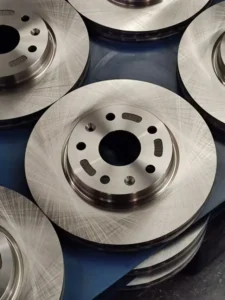
Why Grinding Matters for Brake Discs
Brake discs (or rotors) are typically made of gray cast iron(HT250)—a material chosen for its excellent thermal conductivity and damping properties. However, raw cast iron has surface irregularities, scale, and runout issues. Grinding isn’t just about making the disc look shiny; it’s about:
-
Parallelism: Ensuring both sides of the disc are perfectly parallel to prevent disc thickness variation (DTV), the primary cause of brake judder.
-
Surface Finish (Ra): Creating the right roughness. Too smooth, and the brake pads won’t bed in properly. Too rough, and the pads wear down instantly.
-
Flatness: Eliminating coning or waviness to ensure full pad contact.
The Anatomy of a Brake Disc Grinding Wheel
Not any wheel will do. Grinding cast iron is a unique challenge because the material produces “graphite smearing” and tends to load the wheel. Here is what a specialized wheel looks like:
-
The Abrasive: While white aluminum oxide is common for steel, Silicon Carbide (SiC) is often the champion for cast iron brake discs. It is sharper, harder, and fractures more easily, keeping the cutting edge exposed. For high-production runs, Ceramic (Sol-Gel) abrasives mixed with conventional abrasives are becoming the standard for their exceptional life span.
-
The Bond: Vitrified bonds (glass/ceramic) dominate the market. They provide the rigidity needed for high-speed through-feed grinding lines while allowing the wheel to “self-sharpen” by shedding dull grains.
-
The Structure: Brake disc wheels need a very open structure (high porosity). This allows coolant to reach the grinding zone and, crucially, allows the gray cast iron dust (swarf) to exit the wheel face—preventing the “loading” that would burn the rotor.
The Grinding Process: Blanchard vs. Double-Disc
There are two primary methods for grinding brake discs, and they require different wheel geometries.
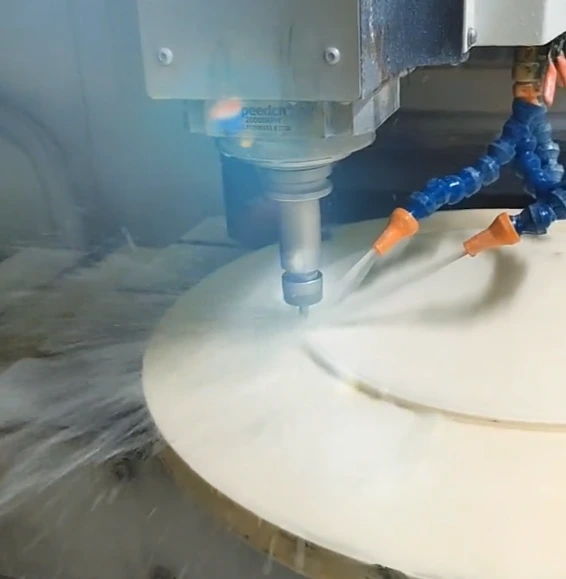
1. Rotary Surface Grinding (Blanchard)
-
Wheel type: Segmented blocks mounted on a rotating head.
-
Best for: Heavy stock removal from one side at a time.
-
Challenge: Maintaining parallelism requires flipping the part.
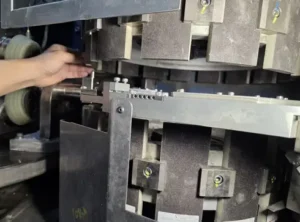
2. Double-Disc Grinding (DDG)
-
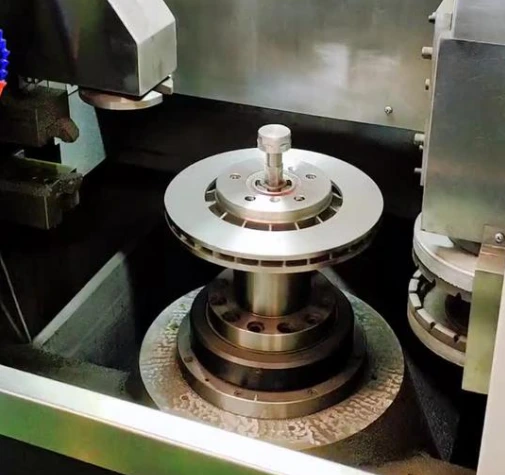
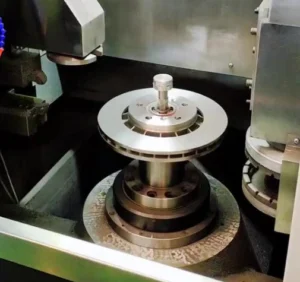
Wheel type: Two annular (ring-shaped) vertical spindles. The disc passes horizontally between two opposing wheels.
-
Best for: High-volume automotive production.
-
Why it’s superior: Because it grinds both sides simultaneously, it guarantees near-perfect parallelism and eliminates the need for flipping.
The “Crazing” Conundrum
The most technical risk in brake disc grinding is thermal damage. Because brake discs are thin and have a large surface area, they are prone to heat buildup. If the wheel is too dull or the coolant flow is insufficient, micro-cracks or “crazing” appear on the rotor surface.
In a non-safety part, a crack is a cosmetic issue. On a brake disc, a micro-crack is a stress riser. Under the thermal shock of heavy braking, that micro-crack grows into a full rotor fracture. Hence, the grinding wheel must be “free cutting”—aggressive enough to cut cool, yet fine enough to finish smooth.
Choosing the Right Wheel Specifications
If you are specifying a wheel for a brake disc line, you are looking for a balance between metal removal rate (MRR) and finish. A typical starting spec for Double-Disc grinding of automotive rotors might be:
-
Abrasive: 39C (Green Silicon Carbide)
-
Grit: 60/80 mesh (for a balance of cut and finish)
-
Grade: H to I (Medium hardness)
-
Structure: 10 or higher (Open)
-
Bond: Vitrified (V)
*Note: For high-speed CBN (Cubic Boron Nitride) grinding—the premium standard—the spec changes entirely to electroplated or vitrified CBN wheels, which run at much higher surface speeds (80-100 m/s) but require rigid, high-cost machinery.*
Maintenance: Dressing is Key
A brake disc wheel is only as good as its last dressing. Because cast iron loads the wheel pores, operators must use a diamond dressing roller or stationary dresser frequently. Rotary diamond dressing rolls are particularly popular in DDG lines because they can form the complex contours needed for ventilated disc hubs.
Raising the Bar: Resin-Bonded CBN Wheels for Double-Disc Brake Rotor Grinding
While conventional silicon carbide wheels have served the industry for decades, the demands of modern automotive manufacturing—higher throughput, tighter tolerances, and lower cost-per-part—call for a technological leap. That’s whereresin-bonded CBN (Cubic Boron Nitride) wheels come into their own, particularly in double-disc grinding (DDG) applications for brake discs.
Why Resin-Bonded CBN?
CBN is the second-hardest known material, second only to diamond. But unlike diamond, CBN does not react chemically with iron and carbon—making it the perfect abrasive for machining ferrous materials like gray cast iron. When paired with aresin bond, the result is a wheel that offers unique advantages for high-volume brake disc production:
-
Ultra-High Grit Retention: Resin bonds hold CBN grains firmly, allowing them to stay sharp longer and cut consistently throughout their extended life.
-
Cool Cutting Action: The resin bond provides a degree of “cushioning” at the microscopic level, reducing grinding heat and virtually eliminating the risk of thermal cracks (crazing) on the rotor surface.
-
Exceptional Form Holding:Resin-bonded CBN wheels maintain their profile far longer than conventional wheels. For DDG machines that grind both sides of a ventilated disc simultaneously, this means consistent chamfer angles, land widths, and surface finishes—shift after shift.
-
Cleaner Operation: Less wheel wear means less abrasive dust in the coolant system, reducing filtration costs and machine downtime.
Resin-Bonded CBN vs. Conventional SiC – A Quick Comparison
| Feature | Conventional SiC Wheel | Resin-Bonded CBN Wheel |
|---|---|---|
| Abrasive life | Hours to days | weeks to months |
| Grit consumption | High (constant dressing needed) | Minimal (rarely requires dressing) |
| Thermal stability | Moderate (risk of burning rotor) | Excellent (inherently cool-cutting) |
| Dimensional consistency | Drifts as wheel wears | Stable for millions of parts |
| Cost per part | Low abrasive cost, high dressing cost, more scrap | Higher upfront, dramatically lower long-term cost |
| Typical surface finish (Ra) | 1.0–2.0 µm | 0.4–1.2 µm (finer, more consistent) |
Optimized for Double-Disc Grinding (DDG)
In a DDG setup—where the brake disc passes horizontally between two opposed vertical spindles—every micron counts. Resin-bonded CBN wheels are engineered specifically for this application:
-
Wheel Configuration: Annular (ring) wheels with precisely matched CBN rim widths for simultaneous grinding of left and right rotor faces.
-
Grit Specification: Typically B91–B126 (equivalent to 120–170 mesh), balancing aggressive stock removal with a finish ready for final braking performance.
-
Concentration: 100–150 concentration (4.4–6.6 ct/cm³) for aggressive cutting action without excessive heat.
-
Resin Formulation: A proprietary heat-resistant resin system that maintains bond strength even under high-pressure, high-flow coolant environments.
What This Means for Your Brake Disc Line
Switching to resin-bonded CBN wheels for double-disc grinding delivers measurable improvements:
-
Parallelism within 5–10 microns – Eliminates disc thickness variation (DTV) judder claims.
-
Zero thermal damage – No micro-cracks, no white layer, no scrap due to burn.
-
24/7 production capability – Run lights-out shifts without operator intervention for wheel changes or dressing.
-
Lower total cost – One CBN wheel can outlast 50–100 conventional wheels, while reducing dressing downtime and coolant maintenance.
Getting the Most from Your Resin-Bonded CBN Wheels
To maximize performance, remember:
-
Use the right coolant: A high-quality, filtered synthetic or semi-synthetic coolant at 3–5% concentration ensures chip evacuation and temperature control. Avoid heavy oils that can degrade the resin bond over time.
-
True before you grind: A single, careful truing operation with a silicon carbide or diamond roll establishes the perfect profile. Unlike conventional wheels, you won’t need to dress regularly after that.
-
Match the machine: CBN grinding requires higher spindle power (typically 15–30 kW per spindle) and rigid machine construction to handle the higher tangential forces.
The Bottom Line
If you’re still grinding brake discs with conventional abrasives, you’re leaving efficiency—and profit—on the table. Resin-bonded CBN wheels for double-disc grinding represent the modern standard: faster cycle times, perfect metallurgical integrity, and a cost structure that rewards high-volume production.
Whether you produce millions of rotors per year for OEMs or high-performance discs for the aftermarket, resin-bonded CBN wheels deliver the precision, reliability, and economy your line demands.
Ready to upgrade your DDG process? Contact us to discuss your rotor specifications, machine type, and current challenges. We’ll help you select the optimal resin-bonded CBN wheel for your brake disc application.